A water heater leaking from bottom of the tank is either a cheap fix or a replacement job, and the trick is working out which one before you spend any money. If the water comes from the drain valve, a pipe fitting or the relief valve, it is usually repairable. If it comes through the tank itself, the heater has to be replaced.
I’ll show you how to shut things down safely, how to find where the water is really coming from, and how to decide between repairing and replacing, for gas and electric heaters.
Quick answer
- Turn off the power (electric) or set the gas control to off or pilot (gas).
- Close the cold water inlet valve on top of the tank.
- Dry everything with a towel, then watch to see exactly where the new drops appear.
- Drain valve, relief valve, a pipe fitting or an electric element gasket: usually fixable.
- Water seeping out of the tank body or from underneath the jacket: the tank has failed and needs replacing.
- Not sure? Leave the water off and call a plumber. A small leak can turn into a flood without warning.
Do this first: stop the leak from getting worse
Safety note: Electric heaters run on 240 volts, gas heaters involve a flame and a fuel line, and the water inside can scald. Never put your hands near wet wiring. If the leak is heavy, the floor around the heater is soaked, or you smell gas, stay out, shut off what you safely can and call a professional or your gas company.
- Cut the energy. For an electric heater, switch off its breaker at the panel. For a gas heater, turn the control dial to “off” or “pilot.” An electric element running while the tank loses water can burn out quickly.
- Close the cold water inlet. It is the pipe on top of the tank. Turn the valve clockwise, or turn the lever so it sits across the pipe. No shutoff valve there? Close the main water valve for the house.
- Put a bucket or towels down and mop up the standing water, so you can see what is new.
- Leave the hot faucets alone for now. You only need to drain the tank if the repair requires it.
Do all of this even if the leak looks small. A slow drip can be the first sign of a weakening tank, and it keeps soaking the floor underneath while you decide what to do.
Find where the water is really coming from
This is the step most guides rush past. Water runs downhill. A leak at the top of the tank, at a pipe connection, or from the relief valve can run down the outside of the jacket and collect at the bottom, so it looks like a water heater leaking from bottom when the source is higher up. Fixing the wrong thing is how people waste a whole weekend.
Here is how I’d track it down:
- Wipe everything dry. Tank, pipes, valves and the floor.
- Press a dry paper towel against each suspect spot in turn: the drain valve, the relief valve and its discharge pipe, the hot and cold connections on top, and the lower access panel on an electric heater.
- Wait 15 to 30 minutes and check which towel is wet. A slow leak sometimes needs a few hours, so look again later.
- Feel the jacket. A cold, wet patch, or a spot where the insulation feels soggy, shows where water is escaping inside the tank wrapper.
- On an electric heater, look behind the side panels. Turn the power off first, remove the cover, and gently pull the insulation aside to check around the heating elements.
- On a gas heater, look under the tank. If you can safely see into the burner area, rust or water on top of the burner chamber is a bad sign. Keep the gas off while you look.
A pan under the heater, if you have one, tells you a lot too. Water in the pan means something leaked. Check where the pan’s drain pipe goes so you know the water isn’t being carried away somewhere unnoticed.
Is it a leak at all? The condensation test
Gas heaters, and any heater that is filling with cold water, can sweat. Moisture gathers on a cold tank, drips off the bottom and looks like a leak. To check, wipe the tank dry and watch it. If water does not come back within an hour or so, and the puddle only appears after a big fill of cold water or on humid days, it is probably condensation. If it comes back no matter what, treat it as a real leak.
Common reasons for a water heater leaking from bottom
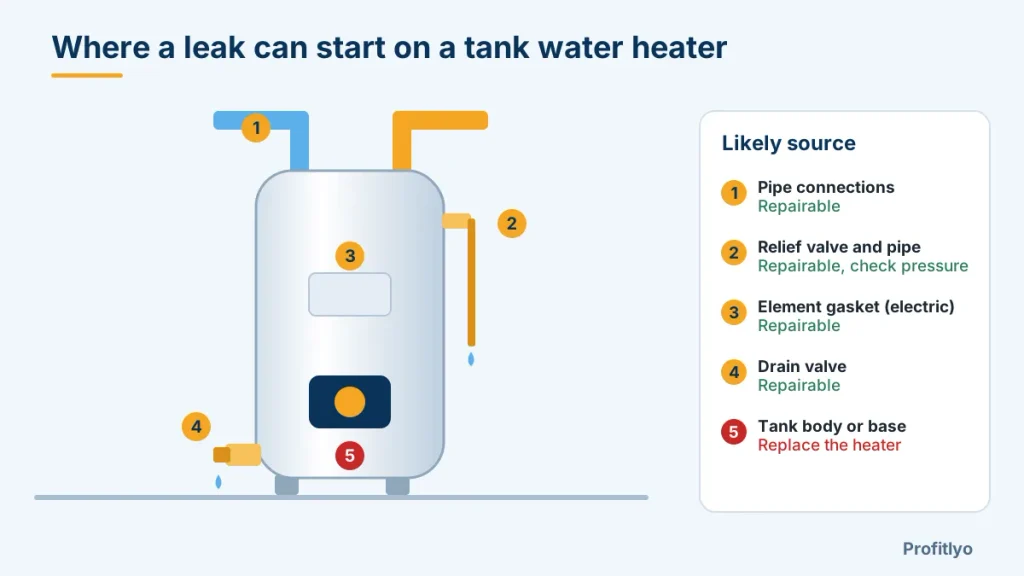
1. A leaking drain valve
This is the most common easy fix. The drain valve sits near the bottom of the tank and is often plastic on cheaper models, which wears out, cracks, or gets grit stuck in the seat. If water drips from the spout, closing it fully or flushing a little water through can sometimes seat it again. If it still drips, or leaks where it meets the tank, replace it. A brass valve is a good upgrade.
Be careful here. Replacing a drain valve means draining the tank, so do the safety steps first and refill the tank completely before turning the power or gas back on.
2. The temperature and pressure (T&P) relief valve
This safety valve opens to release water if the temperature or pressure inside the tank climbs too high. It has a discharge pipe that runs down toward the floor, so a leak there can easily look like a leak from the bottom of the heater. Two things can cause it:
- The valve itself is worn out and drips even when conditions are normal. Replace it.
- The valve is doing its job. Water pressure or heat really is too high, so it opens. If you replace the valve and it keeps leaking, the real problem is the pressure or the thermostat.
Pressure is worth checking. Water expands when it heats, and if your plumbing is a closed system (for example a check valve or pressure reducing valve on the incoming line) that extra volume has nowhere to go, so pressure spikes every time the heater runs. That is called thermal expansion, and an expansion tank is the usual cure. A cheap pressure gauge on a hose bib will show your household pressure. Many plumbers want it at or below about 80 PSI, so if yours is higher, or it climbs when the heater fires, ask a plumber about a pressure reducing valve or an expansion tank.
Never cap or plug a relief valve discharge pipe. If you do, you have removed the thing that stops a tank from becoming dangerous.
3. Loose or worn pipe connections on top
The hot outlet, cold inlet and any flexible connectors can drip, and the water follows the tank down to the floor. Dry the area and check these with a paper towel. A leaking flex connector can often be replaced cheaply. A fitting that just needs tightening or fresh thread tape is a quick fix, but only if the tank itself is dry.
4. An electric heater’s element gasket
Electric tanks have one or two heating elements that thread into the side of the tank behind a small cover. A gasket seals each one, and over time it can harden or the element can corrode. Water then seeps out, soaks the insulation and runs down to the bottom. If you find water behind the cover, the fix is to replace the element and gasket, which means draining the tank below that element first. That is a sensible job for a confident DIYer with the breaker off and a voltage tester, and an easy one for a plumber.
5. A corroded or cracked tank
This is the one nobody wants. Inside the tank is a steel shell with a glass lining. Over the years the lining cracks, the steel rusts, and eventually it develops a pinhole. A tank leak usually shows up as water coming from the bottom of the jacket or from the base, often with rust-colored streaks, with every pipe, valve and fitting above it bone dry. It cannot be patched in any lasting way.
Some small leaks at tank-mounted fittings, like the anode rod port or the nipples on top, can be resealed. But if a fitting that was dry before is now seeping, it can mean the tank is rusting through around it, so don’t count on that repair lasting.
6. Sediment and age
Sediment itself doesn’t poke holes in a tank, but heavy buildup makes the heater run hotter and harder, and it can hide corrosion at the bottom. Hard water makes it worse. If you’ve never flushed the tank, my guide on how to flush a water heater covers it. If the heater is old and leaking, though, flushing won’t save it, and I’d hold off on stirring things up.
Repair or replace: how I’d decide
This is the question that matters, so here is a plain rule of thumb. It’s mine, not a manufacturer’s rule.
- Water comes from the drain valve, relief valve, a connector or an element gasket, and the tank is dry: repair it, whatever the age.
- Water comes from the tank body, the base or the jacket, with everything else dry: replace the heater. Age doesn’t matter here, because a leaking tank is finished.
- The heater is about 10 years old or more and leaking from anywhere: I’d seriously consider replacing it. The sources vary on how long a tank lasts, with figures from about 8 up to 12 years being common, and your water quality and maintenance change it. A repair on a heater that is near the end of its life often just buys you a few months.
Check the serial number or label on the tank. Many manufacturers encode the manufacture date in the serial number, and a plumber or the manufacturer’s website can decode it.
What does it cost?
Prices depend heavily on where you live, so treat these as ballparks and get a local quote. One plumbing company, Summers Plumbing, lists roughly $100 to $250 for a drain valve repair, $150 to $350 for a T&P valve, and $100 to $300 for a connection repair. For a full tank replacement, Fixr listed installed costs in early 2026 of about $700 to $2,700 for a natural gas tank and about $500 to $3,500 for electric, labor included. Summers puts a new tank installation higher, at about $1,000 to $3,500 or more. Those numbers don’t line up exactly, which is itself a good reason to ask for two or three quotes.
Is a leaking water heater dangerous?
It can be, which is why I don’t like waiting on one. The main risks are:
- Electric shock. Water near a 240-volt heater and its wiring is a real hazard.
- Water damage. A leak that is small today can fail completely and dump a whole tank on the floor, and it soaks drywall, flooring and anything stored nearby.
- Mold. A slow, hidden leak can keep things damp for weeks.
- Scalding. The water is hot, and so is the pipe coming from the relief valve.
- Gas. If you smell gas, leave the house and call your gas company before anything else.
A heater that is dripping a little from a valve is not an emergency. One that is steadily leaking from the tank is, even if it looks small. Shut off the energy and the water and plan the replacement.
What about tankless and heat pump water heaters?
A tankless heater has no tank to rust through, so a leak usually comes from a fitting, the water connections, or the heat exchanger, and a scale-clogged unit can cause trouble too. A leak from the unit body is a job for a pro, and it may be covered by a warranty. A heat pump water heater has a tank like a normal electric one, and it also makes condensate that drains away through a small line, so a clogged condensate drain can look like a leak. I’ll write a separate guide on tankless maintenance.
Mistakes to avoid
- Leaving the power on. An electric element out of water burns out fast, and wet wiring is a danger.
- Replacing parts without finding the source. Water runs, so confirm where it starts.
- Plugging the relief valve pipe. It is a safety device, and plugging it is dangerous.
- Using sealant on a leaking tank. Patches on a failing tank are a short-term gamble at best.
- Ignoring a small puddle. The floor under a heater can rot before you notice.
- Turning the heat back on before the tank is full. Refill completely, with a hot faucet open until water runs steadily, then restore power.
When I’d call a plumber instead
- You can’t tell where the water is coming from
- Water is coming from the tank body or base
- The relief valve leaks and the pressure checks out normal
- You smell gas, or you are uncomfortable with gas or 240-volt wiring
- The heater is about 10 years old or more
- The leak is heavy, or the floor around the tank is wet
Frequently asked questions
Why is my water heater leaking from the bottom?
The usual causes are a worn drain valve, a leaking relief valve or its discharge pipe, a loose connection above that runs down the tank, an electric element gasket, condensation, or a corroded tank. Dry everything and watch to find the real source.
Can I fix a water heater leaking from the bottom of the tank?
If the water comes through the tank itself, no, it has to be replaced. If it comes from a valve, a connector or an element gasket, those parts can be repaired or replaced.
Is it safe to use my water heater if it is leaking?
I wouldn’t. Turn off the power or gas and close the cold water inlet until you know the source. A tank leak should be treated as urgent.
How long can a water heater leak before it fails?
There is no safe answer. Some drip for a long time, and others fail suddenly. A leak from the tank body means it is done, so don’t wait to see how long it lasts.
Why does my water heater leak from the relief valve pipe?
Either the valve is worn, or pressure or temperature is too high, often because of thermal expansion. Check your household water pressure and ask a plumber about an expansion tank if it is high.
Is a leaking water heater covered by warranty?
Often only for a limited period, and usually for the tank itself, not for labor or water damage. Check your warranty paperwork and the serial number date before you pay for a repair or a new tank.
Final thoughts
The bottom of the tank is where all the water ends up, so it is rarely where the leak starts. Shut off the power or gas and the cold water, dry everything, and find the real source before you buy a part. Valves, connectors and element gaskets can be repaired, and a leaking tank body means replacement. If you are unsure, a plumber’s visit costs far less than a flooded basement.
Once the leak is sorted, flushing the tank, checking the anode rod and relighting a pilot light are the maintenance jobs I’d look at next.