To relight a water heater pilot light, turn the gas control to off and wait at least 10 minutes, set it to pilot and push it in, light the flame while you hold the knob down, keep holding for about a minute, then release it and turn the control to on.
The whole job usually takes 15 to 30 minutes. If you smell gas at any point, stop and leave the house.
I’ll walk you through the exact steps, what a healthy flame looks like, why the pilot keeps going out, and how to tell when it is time to call a plumber.
This guide is for gas tank heaters only, since electric heaters have no pilot light.
Quick answer
- Smell for gas first. If you smell it, do not relight. Leave and call your gas company.
- Turn the gas control knob to OFF and wait at least 10 minutes.
- Turn the knob to PILOT and push it in.
- Light the pilot with the igniter button or a long lighter while holding the knob in.
- Keep holding the knob for 30 to 60 seconds after the flame lights, then release it slowly.
- If the flame stays lit, turn the knob to ON. If it goes out, wait and try again, up to three times.
- Still won’t stay lit after three tries? Call a professional.
Does your water heater even have a pilot light?
This is the first thing to check, and many guides skip it. Not every gas water heater has a pilot light you light by hand. There are three common setups:
- Standing pilot. A small flame burns all the time. You relight it with a button or a lighter, using the steps below.
- Electronic ignition. A spark or a hot surface igniter lights the burner when it is needed. Many newer heaters work this way, and there is no flame for you to light. Some models still have an igniter button and a status light, so check your label.
- Electric heater. No gas and no pilot. If your heater is electric, the problem is somewhere else, usually the breaker, a reset button or a heating element.
My guide on a hot water heater not working covers those electric checks step by step.
Look at the label on the tank and at the gas control valve near the bottom.
If you see a knob with OFF, PILOT and ON, and a small window or access panel to see the flame, you have a standing pilot. If you see only a dial and a flashing status light, you likely have electronic ignition, and the lighting instructions on the label will tell you what to do.
One more thing.
The instructions printed on your own heater come before anything I write here. Models differ, and a guide from the manufacturer is always the final word on yours.
Safety first
Safety note: If you smell gas, especially a rotten egg smell, do not relight the pilot. Do not flip any light switches. Open a window if you safely can, leave the house, and call your gas company or the fire department from outside. Only relight a pilot if you are comfortable working with gas, and call a licensed plumber if you are not.
- Smell before you touch anything. Natural gas is lighter than air and tends to rise, while propane is heavier and can collect near the floor, which is where your heater sits. Put your nose near the floor around the heater too.
- Ventilate the room. Open a door or window and keep flammable things, like paint, gasoline cans and cleaners, well away from the heater.
- Wait before you light. Gas left in the area after you turn the control off needs time to clear. Sources differ here. A. O. Smith says to wait at least 10 minutes, while some others say 5. I’d go with 10 minutes, and longer is fine.
- Use a long lighter and a flashlight. It keeps your hand away from the burner area.
How to relight a water heater pilot light, step by step
Step 1: Turn off the gas control and wait
Find the gas control valve, usually near the bottom of the tank. Turn the knob to OFF. Now wait at least 10 minutes. Use that time to open a window and gather your tools.
Step 2: Open the access panel
Remove the small cover at the base of the heater, or find the viewing window, so you can see the pilot and the burner. Use a flashlight to look inside. Some newer heaters are sealed so you can only see the flame through a small window, and those usually have an igniter button instead of needing a lighter.
Step 3: Set the knob to pilot and push it in
Turn the knob to PILOT. Then push it in. It should move in a short distance, about a quarter of an inch. You keep it pushed in for the next steps.
Step 4: Light the pilot
If your heater has an igniter button, hold the knob in and press the button, about once a second, until the pilot lights. If there is no igniter, hold a long lighter or match to the pilot opening while you keep the knob pushed in. The pilot should catch within a few seconds.
Step 5: Keep holding the knob
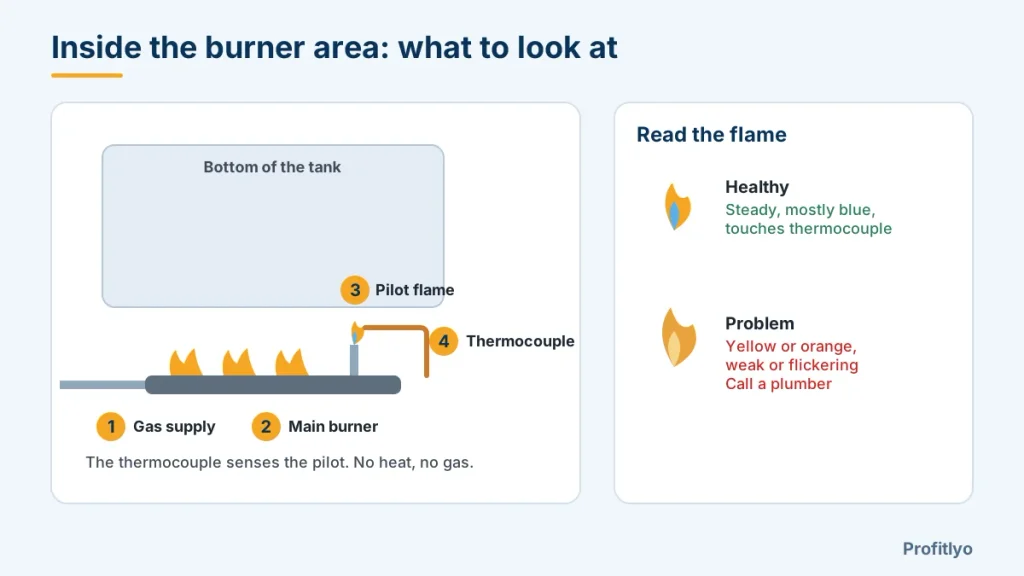
This is the step people rush. After the flame lights, keep the knob pushed in for 30 to 60 seconds. The part that tells the gas valve a flame is present is the thermocouple, and it needs time to heat up. Let go too early and the valve shuts the gas off again, so the pilot dies.
Step 6: Release slowly and check the flame
Let the knob come back out slowly. The pilot should stay lit. If it goes out, wait 5 to 10 minutes and repeat from Step 3. You may need two or three tries, but don’t keep going past three.
Step 7: Turn the knob to ON
Once the pilot burns steadily, turn the knob to ON or to your preferred temperature setting. You should hear a soft whoosh when the main burner lights. Put the cover back.
Step 8: Give it time and check again
A full tank takes a while to heat. Expect hot water in roughly 30 to 60 minutes. After that, run a hot tap to confirm it is heating, and check back after an hour that the pilot is still lit.
What a healthy pilot flame looks like
The flame tells you a lot. A good pilot flame is mostly blue, with maybe a small yellow tip. It is steady and it touches the tip of the thermocouple. A weak flame, a flame that flickers all the time, or one that is mostly yellow or orange is a warning sign. It can mean dirt in the pilot tube, poor airflow or a problem with the gas supply. If your flame looks wrong, even if it stays lit, I’d have it looked at. A yellow, sooty flame can also be a sign of poor combustion, which is a carbon monoxide risk, so don’t ignore it.
Why your water heater pilot light keeps going out
If it goes out once after a storm or a gas interruption, that’s normal. If it keeps going out, one of these is usually the reason:
- A dirty or worn thermocouple. If it can’t sense the flame, it tells the valve to shut the gas off. A little soot on the tip can be enough. Some guides suggest gently cleaning the tip with fine sandpaper. If that doesn’t help, the part can be replaced, and one source puts the part itself at under $20. Gas work isn’t a beginner job, so I’d leave the replacement to a plumber unless you are experienced.
- Drafts. An open door, a window or a vent blowing across the heater can puff out the flame.
- A clogged pilot tube or orifice. Dust, lint and even spider webs can restrict the flame. This needs a careful cleaning by a professional.
- Not enough air. A heater in a tight closet can starve the flame of the air it needs. Unburned fuel or carbon monoxide can then end up in the house, so a technician should check the installation.
- A gas supply problem. Check if your other gas appliances work normally. If they don’t, the issue is outside the heater.
- A failing gas control valve. This is more common on older heaters and needs replacing by a pro.
- Sediment buildup. A thick layer of sediment can make the tank overheat and trip the safety shutoff. If you haven’t flushed the tank in a while, my guide on how to flush a water heater shows you how, once the pilot issue is sorted out.
Mistakes to avoid
- Relighting when you smell gas. Never. Leave and call for help.
- Not waiting long enough. Light a flame into leftover gas and you risk a flash.
- Releasing the knob too early. The thermocouple needs 30 to 60 seconds to warm up.
- Trying again and again. If it fails three times, something is wrong. More attempts won’t fix it.
- Ignoring a yellow or orange flame. It can mean poor combustion.
- Relighting a heater that is leaking. If you see water around the tank, deal with the leak first. My guide on a water heater leaking from the bottom covers how to find the source.
When I’d call a plumber instead
- You smell gas at any point, or hear hissing near a gas connection
- The pilot won’t stay lit after three tries
- The flame is yellow, orange or very weak
- You see soot, scorch marks or rust near the burner
- Your heater has electronic ignition and won’t fire
- The heater is about 10 years old or more and keeps having problems
- You are not comfortable working with gas
On the last point, age matters. Most gas tanks last somewhere around 8 to 12 years, so if an older heater keeps losing its pilot, a repair may only buy you a little time.
Frequently asked questions
How do I relight a water heater pilot light?
Turn the gas control to off and wait at least 10 minutes. Set it to pilot, push it in, light the flame with the igniter or a long lighter, hold the knob down for 30 to 60 seconds, then release it and turn the control to on.
How long should I wait before relighting the pilot?
At least 10 minutes is the safest rule, since that is what A. O. Smith advises. Some sources say 5 minutes, but waiting longer costs you nothing.
Why won’t my water heater pilot light stay lit?
The most common reasons are a dirty or worn thermocouple, a draft, a clogged pilot tube, poor airflow around the heater or a failing gas control valve. Make sure you held the knob down long enough too.
Is it safe to relight a pilot light myself?
For a standing pilot, with no gas smell and a manual in hand, many homeowners do it. If you smell gas, aren’t comfortable around gas, or the pilot won’t stay lit, call a licensed plumber.
What color should a pilot light be?
Mostly blue with a small yellow tip, steady and touching the thermocouple. A yellow or orange flame, or a weak flickering one, needs attention.
Does an electric water heater have a pilot light?
No. Electric heaters have no pilot light. If you have no hot water, check the breaker, the reset button and the heating elements instead.
How do I know if the pilot light is out?
You’ll usually have little or no hot water and no burner sound. If you remove the access panel or look through the window, you won’t see a flame. A newer heater may show a flashing status light or an error code.
Final thoughts
Relighting a pilot is a short job if you take it slowly. Check for gas first, wait the full 10 minutes, and hold the knob down long enough for the thermocouple to warm up. If the pilot goes out again and again, treat it as a sign of a real problem and call a plumber rather than relighting it over and over.
Once your heater is running again, it is also a good moment to read my guide on how to flush a water heater, since sediment can cause the kind of overheating that trips the safety shutoff.