A hot water heater not working usually comes down to a short list of causes.
On an electric heater, it is most often a tripped breaker, a tripped reset button, a failed heating element or a bad thermostat. On a gas heater, it is usually a pilot light that went out, a gas supply problem or a thermocouple that isn’t doing its job. Most of these take minutes to check.
I’ll walk you through the checks in the order I’d do them, for gas and electric, and tell you which problems are safe to fix yourself and which ones need a plumber or an electrician.
Quick answer
- Check whether it is the heater or just one tap. If only one faucet is cold, the heater is probably fine.
- Electric: check the breaker, then press the red reset button on the upper thermostat once.
- Gas: check that the gas is on and the pilot light is lit. My pilot light guide shows how to relight it safely.
- Check the thermostat setting. Around 120°F is the usual recommendation.
- No hot water at all points to the upper element on an electric heater. Lukewarm water points to the lower element or a thermostat.
- If the breaker or reset button trips again, or you smell gas, stop and call a professional.
Safety first
Safety note: Electric water heaters run on 240 volts, and gas heaters involve a flame and a fuel line. If you smell gas, leave the house, don’t touch any switches, and call your gas company or the fire department from outside. Turn the power off at the breaker before you open any access panel, and never trust that it is off without checking.
Is it really the water heater?
This one is easy to miss. Before you open any panels, work out where the problem is:
- Only one faucet is cold or lukewarm. The heater is probably fine. The usual suspects are that tap’s valve or cartridge, or a mixing valve in a shower.
- Every hot tap is cold. That points to the heater itself.
- Hot water runs out too fast. The heater may be working but be too small, or the lower heating element or thermostat is failing.
- Water is pooling around the tank. Deal with the leak first. My guide on a water heater leaking from the bottom shows how to find the source and decide whether to repair or replace.
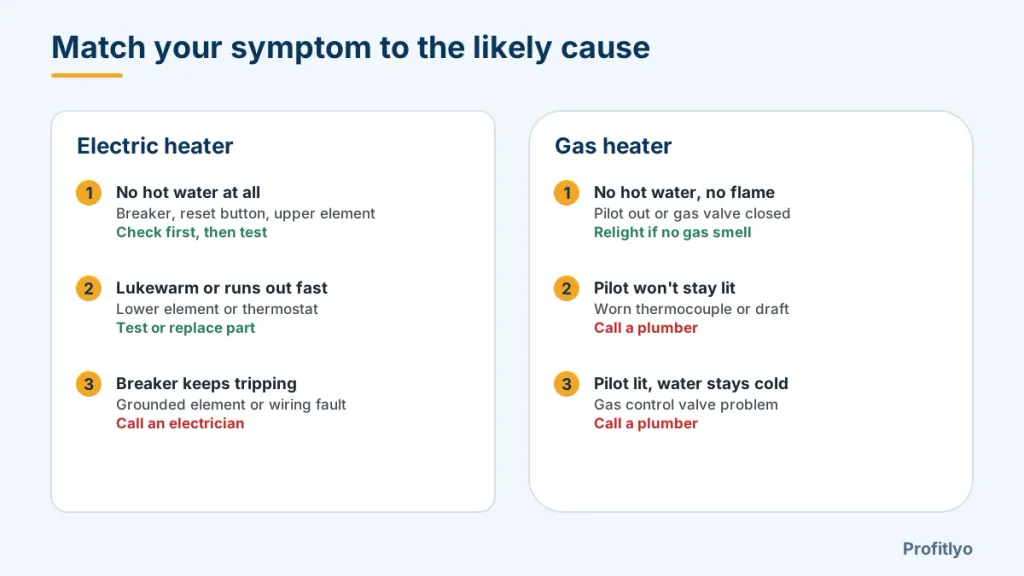
Which symptom matches yours?
The symptom narrows down the cause a lot.
Here is how I match them up on an electric heater, and where a gas heater differs.
- No hot water at all (electric): breaker, tripped reset button, or the upper element or thermostat.
- Lukewarm water (electric): the lower element or its thermostat, or the upper element failing.
- Runs out quickly: lower element, a thermostat set too low, or heavy sediment.
- Water too hot: a stuck thermostat or one set too high.
- Breaker keeps tripping: a grounded element or a wiring fault. Call an electrician.
- No hot water (gas): pilot out, no gas, a bad thermocouple or a gas control valve problem.
Hot water heater not working: 9 causes and fixes
1. A tripped breaker (electric)
This is the most common reason an electric heater goes cold, and the easiest to check.
Find the double-pole breaker for the heater, which is usually a 30-amp one, and make sure it is fully on. If it is tripped, switch it off, then back on, once.
If it trips again straight away or soon after, don’t keep resetting it. Something is shorted, and that is a job for an electrician.
2. The reset button has tripped (electric)
Electric heaters have a high-limit safety switch with a red reset button, usually on the upper thermostat. It trips if the water gets too hot.
To try it, turn the power off at the breaker, remove the upper access panel, push the insulation aside, and press the red button until it clicks. Put everything back, restore the power and wait. Reheating a full tank can take an hour or more.
Press it once. If it trips again within a few hours, something is wrong, most often a failing element or thermostat, and pressing it again won’t fix that.
3. A failed heating element (electric)
An electric tank has two elements, an upper and a lower one. If the upper element fails, you usually get no hot water at all. If the lower one fails, you get some hot water that runs out fast, or only lukewarm water.
You can test an element with a multimeter, and I’ll cover that below. Replacing one means draining the tank below the element, which is a fine job for a confident DIYer or a quick one for a plumber.
4. A bad thermostat (electric)
Each element has its own thermostat. A thermostat that has failed can leave the element cold, or leave it on and trip the reset button. Thermostats are cheap parts, but wiring on a 240-volt circuit is not a place to experiment.
5. The pilot light is out (gas)
On a gas heater with a standing pilot, a pilot that has blown out means no flame and no hot water. Gas tanks usually reheat in around 30 to 40 minutes once it is lit again.
If you smell gas, don’t relight it. If it is safe, follow my guide on how to relight a water heater pilot light, including the part about holding the knob down long enough for the thermocouple to warm up. If it keeps going out, a worn thermocouple is the usual cause, and that part is worth having a plumber replace.
If your heater has electronic ignition, there’s no pilot to relight. Check the status light, the breaker for any power supply to the heater and the manual, and call a professional if it still won’t fire.
6. A gas supply or gas control valve problem (gas)
Check that the gas valve to the heater is open and that your other gas appliances work.
If the pilot is lit but the water never heats, or the temperature dial can’t get the water hot, the gas control valve may be failing. This is a professional repair. Don’t take apart a gas valve yourself.
7. The thermostat is set too low (or got turned off)
It sounds silly, but a thermostat that was bumped, or turned down during a holiday, is a real cause. A. O. Smith recommends about 120°F for a good balance of heating speed, energy cost and safety.
Other guides suggest anywhere from 122°F up to 140°F. Hotter water raises the risk of scalds, so I’d start at 120°F and only go up if you really need to. On an electric heater, check that both thermostats are set to the same temperature.
8. Sediment in the tank
Sediment makes the heater work harder and can cut how much hot water you get, and a lot of it can make a heater overheat and trip its safety switches.
If you haven’t flushed the tank in a while, my guide on how to flush a water heater covers it. Flushing doesn’t fix a failed part, but it is a sensible thing to do while you are at it.
9. Your hot water demand is too high for the tank
If the heater works but you keep running out, it might be sized too small for your household. An electric tank recovers more slowly than a gas one, roughly an hour or more against 30 to 40 minutes for gas on a typical tank.
Staggering showers, or avoiding using hot water while the tank is reheating, helps. A bigger tank or a different type of heater is the longer-term fix.
If you go tankless, my guide to tankless water heater maintenance explains how to look after it.
Other causes that are less common
- A broken dip tube. It sends cold water down to the bottom of the tank. If it cracks, cold water can mix in at the top and make your hot water lukewarm.
- Cold weather. A heater in an unheated space, or very cold incoming water, takes longer to catch up.
- Blocked air screens on a gas heater. Dust and lint can choke the burner’s air supply.
Testing a heating element with a multimeter
Only do this if you already own a multimeter and are comfortable with it.
First, switch off the breaker and confirm the power is off with the meter. Then disconnect one wire from the element and set the meter to its lowest ohms range.
- A healthy element typically reads somewhere around 10 to 20 ohms, depending on its wattage. One guide lists about 16 ohms for a 3,500-watt element and about 10 to 11 for a 5,500-watt one.
- A reading of zero means shorted. An open or infinite reading means the element is broken. Either way, replace it.
- Touch one probe to an element terminal and the other to bare tank metal. A healthy element reads infinite. Any reading at all means it is grounded, which is a common reason for a breaker that keeps tripping.
If the thought of working near a 240-volt heater makes you uneasy, that is a good reason to call a professional. It is not a sign you did anything wrong.
What does it cost to fix?
Prices vary a lot by area, so treat these as examples.
One electric heater repair company in the Pacific Northwest lists about $300 to $450 for an element replacement, parts and labor, and around $150 for a thermostat.
If the heater has to be replaced, ARS lists a standard tank at about $2,300 to $3,500 installed, while Fixr listed $600 to $2,500 for tank-style heaters in early 2026. Those figures are far apart, which is a good reason to get two or three local quotes.
Repair or replace?
I’d use the same rule I gave in my leak guide.
A failed element, thermostat, breaker or pilot is a repair, whatever the age. But if the heater is about 10 years old or more and is also leaking, noisy or failing in more than one way, a new heater usually makes more sense than putting parts into an old tank.
Typical tank life is quoted as roughly 8 to 12 years by some sources and up to 15 by others, so it depends on your water and how well it was looked after.
Mistakes to avoid
- Resetting the breaker again and again. If it trips twice, stop. Something is shorted.
- Working on the heater with the power on. Switch it off and check it is off.
- Relighting a pilot when you can smell gas. Never.
- Turning the power on before the tank is full. An element running dry burns out within minutes.
- Cranking the thermostat up to fix lukewarm water. It doesn’t repair a failed element, and it raises the scald risk.
- Replacing parts without testing. Pressing the reset button and checking the breaker costs nothing. Buying an element you don’t need does.
When I’d call a plumber or an electrician
- You smell gas, or hear a hiss near the gas line
- The breaker or reset button trips more than once
- You suspect a grounded element or a wiring fault
- The gas control valve or thermocouple needs replacing
- There is water leaking from the tank
- The heater is about 10 years old or more and failing
- You aren’t comfortable with 240-volt wiring or gas
Frequently asked questions
Why is my hot water heater not working?
For electric heaters, the usual causes are a tripped breaker, a tripped reset button, a failed element or a bad thermostat. For gas heaters, it is a pilot light that went out, a gas supply problem or a failing thermocouple or gas valve.
Why is my water heater not heating up?
If it is electric, check the breaker and press the reset button once, then check the elements and thermostats. If it is gas, check the gas supply and the pilot. Also check the thermostat setting, since it may have been turned down.
Where is the reset button on a water heater?
On an electric heater, it is a small red button on the upper thermostat, behind the upper access panel. Switch the power off first. Gas heaters don’t have this button, though some have a pilot reset or ignition button.
How long does a water heater take to heat up?
Most gas tanks reheat in roughly 30 to 40 minutes, and electric tanks in about an hour to an hour and a half, depending on the size. Avoid using hot water while it recovers.
Why does my water heater only give lukewarm water?
On an electric heater, it is often the lower element or its thermostat, or the upper element is failing. Other causes are a thermostat set too low, sediment, a broken dip tube or a tank that is too small for your demand.
Why does my water heater keep tripping the breaker?
The usual cause is a grounded or shorted element, or a wiring problem. Don’t keep resetting it. Have an electrician or plumber check it.
Why is there no hot water but the pilot light is on?
The gas control valve, the thermostat on the valve or a blocked burner may be at fault, or the thermocouple may be telling the valve there’s no flame. This usually needs a professional.
Should I repair or replace a water heater that isn’t working?
Repair simple failures such as a breaker, element, thermostat or pilot. Consider replacing if the heater is around 10 years old or more and has more than one problem, or the tank is leaking.
Final thoughts
Start with the cheap checks: is it the whole house or one tap, is the breaker on, has the reset button tripped, is the pilot lit, is the thermostat where it should be.
Those fix a surprising number of cases. When a part has failed or a breaker keeps tripping, stop and get a professional, since that is where a small problem can turn into a dangerous one.