Tankless water heater maintenance comes down to three jobs: flush the heat exchanger to remove scale, clean the inlet filter, and check the vents.
Do tankless water heater maintenance about once a year, or every six months if you have hard water. Most of it is a DIY job, and the flush takes around two hours.
I’ll walk you through the schedule, the exact flush steps, what it costs, and when to hand the job to a pro. This guide covers gas and electric units.
Quick answer
- Read your manual first. It overrides any general guide, including this one.
- Tankless water heater maintenance starts with a yearly flush of the heat exchanger, using white vinegar or an approved descaling solution.
- With hard water, flush about every six months instead.
- Clean the inlet water filter every time you flush.
- Keep the vent and air intake clear, and check for leaks and error codes every month.
- Gas smell, damaged vents or error codes that keep coming back mean a professional visit.
Do tankless water heaters need maintenance?
Yes. Tankless heaters have no tank to collect sediment, but minerals still build up inside the heat exchanger.
That scale acts like insulation. It cuts flow, adds noise and makes the unit work harder.
Tankless water heater maintenance is how you keep the unit running for its full life.
A. O. Smith says tankless units typically last 15 to 20 years with proper care and maintenance, and calls hard water the biggest threat.
Tankless water heater maintenance schedule
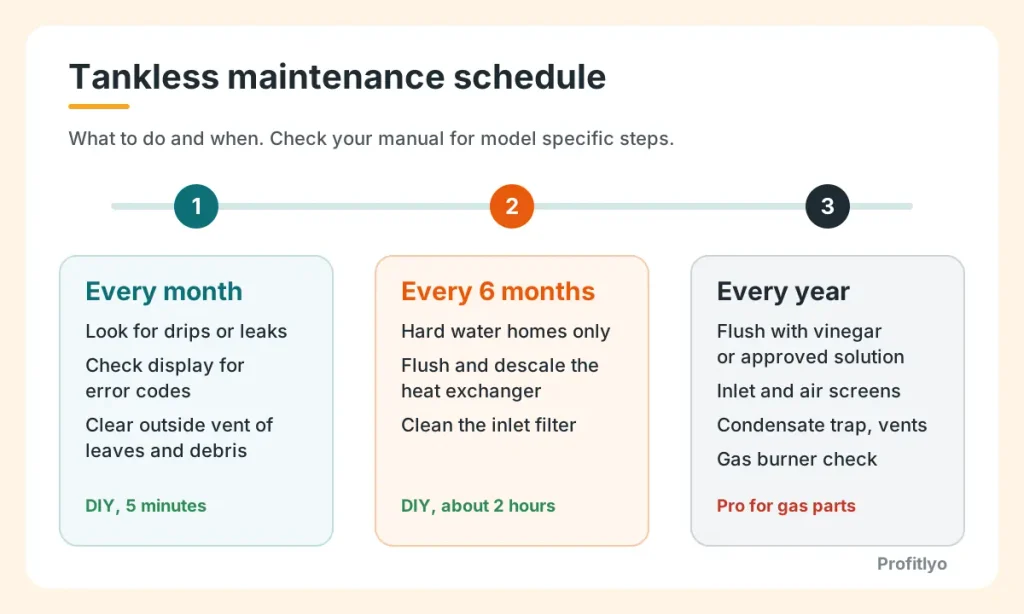
Here is the schedule I’d follow. It pulls together what Navien, Rheem and Aero Energy recommend.
- Every month: look for drips around the unit and pipes, glance at the display for error codes, and check that the outside vent is clear of leaves, nests and debris.
- Every 6 months (hard water or heavy use): flush and descale. Rheem suggests about every six months in hard water areas.
- Once a year: flush the heat exchanger, clean the inlet filter, clean the air intake filter and the condensate trap if your model has them, and check the vent pipes.
- Once a year (optional): book a technician to inspect the burner, sensors and gas connections on a gas unit.
Navien recommends annual tankless water heater maintenance. Rheem says the main tasks should happen at least once a year, often by a professional.
Spring or fall is a good time. Pick one and put it in your calendar.
How hard water changes your tankless water heater maintenance
Hard water is the main reason some heaters need a flush twice a year.
If you don’t know your water hardness, check your water utility’s yearly report or use a cheap test strip. Harder water means scale builds faster.
If you flush every year and the water you drain is full of white flakes, move to every six months.
A whole-house softener is the long-term fix, and Noritz recommends one to cut how often service is needed.
To keep one working well, see my guide to keeping a softener in good shape.
What you need
Gather everything before you start. Tankless water heater maintenance goes smoothly when nothing is missing.
- A small submersible utility pump (Rinnai’s bulletin lists a circulating pump of about 4 gallons per minute)
- Two short hoses, such as garden or washing machine hoses
- A 5-gallon bucket
- 2 to 4 gallons of undiluted white vinegar, or a descaling solution approved for your heater
- A second bucket or access to a floor drain for rinsing
- A soft brush or old toothbrush for the filter
- Your manual, open to the maintenance page
Many heaters have two service valves with caps, one for hot and one for cold. If yours doesn’t, an installer can add them. They make this job far easier.
How to flush a tankless water heater, step by step
This is the part of tankless water heater maintenance that most competitor pages skip. Navien, Noritz and Rheem tell you to flush but don’t show how.
Step 1: Check your manual
Look up the maintenance section for your model. Note the solution it approves and the flush time.
Manufacturers don’t agree. One Rinnai bulletin for its Sensei models calls for four gallons of undiluted white vinegar circulated for at least an hour.
Other guides use 2 to 3 gallons for 45 to 60 minutes. If your manual gives a number, use that one.
Step 2: Turn off power and gas
For an electric unit, switch off its breaker. For a gas unit, close the gas valve with a quarter turn and turn off the power or unplug it.
Don’t work on a unit that is still connected to power. Rinnai’s procedure also says to unplug the unit.
Step 3: Close the water valves
Close the isolation valves on the hot and cold water lines going to the heater.
Then remove the caps from the hot and cold service valve ports. Have a towel ready, since a little water will come out.
Step 4: Connect the hoses and pump
Put the pump in the bucket. Connect a hose from the pump outlet to the cold service valve.
Connect the second hose to the hot service valve and put its free end back into the bucket. This makes a closed loop.
Step 5: Add the vinegar and circulate
Pour the vinegar into the bucket, open both service valves and start the pump.
Let it circulate for 45 to 60 minutes, or longer if your manual says so. If the flow drops, stop the pump and check the filter.
Step 6: Rinse with clean water
Switch off the pump. Move the hot-side hose to a floor drain or an empty bucket.
Close the cold service valve, disconnect the pump, and open the cold isolation valve. Run fresh water through for about 5 minutes, until it runs clear. Don’t reuse the vinegar.
Step 7: Clean the inlet filter
Do this while the water is still off. The steps are in the next section.
Step 8: Close up and reopen the water
Close the service valves, remove the hoses and put the caps back.
Open the hot and cold isolation valves. Then open a hot tap in the house to push air out of the lines.
Step 9: Restore power and test
Turn the gas valve back on and restore power. Run a hot tap for a minute or two.
Check for steady hot water, no leaks at the valves, and no error code on the display. Rinnai’s bulletin also says to check the pump and hoses for leaks as you go.
Tankless water heater maintenance: how to clean the inlet filter
The inlet filter catches grit before it reaches the heat exchanger. A clogged one cuts water flow.
Turn off the water to the unit, put a bowl under the filter, then unscrew it and pull out the screen.
Rinse the screen under cold running water. Use a soft brush if debris is stuck on it.
Put it back and tighten it by hand. Then check for drips when the water is back on.
Navien lists this task for all of its models. Some models also have an air intake screen, which you can clean with a toothbrush and let dry fully.
Condensate trap, vents and other checks
Condensing models drain acidic water through a condensate trap. Navien says to clean the trap, and to check that the o-ring sits properly when you put it back.
Rheem also lists the condensate neutralizer for condensing models. If the media is saturated or worn, it needs replacing.
Look at the vent terminations outside at least once a year. Leaves, nests, snow and ice can block them and trigger error codes or shutdowns.
Gas burners, flame sensors and igniters are a job for a technician. A dirty combustion chamber can produce carbon monoxide, so I wouldn’t open that part myself.
If you live somewhere with freezing winters, know where your isolation valves are. A power cut can stop the built-in freeze protection from working.
Tankless water heater maintenance cost
Prices for tankless water heater maintenance depend on your area and your unit, so treat these as examples.
Angi lists a professional tune-up at $100 to $500, and says tankless maintenance costs are comparable to tank units. It lists a flush at about $110 to $200, though that figure isn’t specific to tankless.
A. O. Smith puts annual descaling at $200 or more per visit. So the gap between a $200 pro visit and a vinegar flush you do yourself is real.
The DIY cost is mostly vinegar, a pump and hoses. If you already own a pump, it is only a few dollars of vinegar.
DIY or professional?
Many homeowners can handle the flush and the filter parts of tankless water heater maintenance. Rheem and Navien both say tasks involving gas or electrical parts should go to a licensed professional.
Warranty matters here. Navien warns that damaging your heater during routine work can void the warranty, and that skipping the manual’s schedule can too.
Check your warranty before you start your tankless water heater maintenance. If your heater is installed under a service plan, a pro visit may be required to keep it valid.
Signs you need tankless water heater maintenance now
Don’t wait for the calendar if you notice any of these:
- Water flow has dropped, or the water takes longer to get hot
- The unit is noisier than before, or you hear banging
- An error code keeps coming back
- White flakes or cloudy water at your taps
- Water temperature that swings between hot and cold
These can also mean a failed part. If the unit won’t heat at all, my guide to a hot water heater not working covers the basic checks for gas and electric heaters.
Mistakes to avoid
Most problems with tankless water heater maintenance come from rushing. Avoid these:
- Skipping the rinse. Leftover vinegar shouldn’t stay in the lines. Run clean water through for about 5 minutes.
- Reusing the vinegar. Rinnai’s procedure says to throw it away after one use.
- Working with the power or gas on. Switch it off first, and confirm it’s off.
- Ignoring your manual. Flush times and solutions differ by brand.
- Forgetting the filter. A flush without a clean filter leaves the main cause of low flow in place.
- Waiting too long between flushes. Heavy scale gets harder to remove each year.
- Opening the burner area yourself. Leave that to a technician.
Tankless water heater maintenance checklist
Here is the short version to print or save.
- Monthly: check for leaks, error codes and a clear vent
- Every 6 to 12 months: flush with vinegar and clean the inlet filter
- Yearly: clean the air screen and condensate trap, check vents outside
- Yearly or as advised: have a technician inspect gas models
- Always: read your manual and keep a note of the date you last flushed
Writing the date down matters. Most people forget when they last did it.
Frequently asked questions
What maintenance does a tankless water heater require?
Flush the heat exchanger once a year, clean the inlet filter, and keep the vents clear. Condensing models also need the condensate trap cleaned.
How often should tankless water heater maintenance be done?
Once a year is the usual advice from Navien, Rheem and Noritz. In hard water areas, about every six months is better.
Can I flush my tankless water heater myself?
Yes, if you are comfortable with a few hoses and a pump. Turn off the power and gas first, and check your warranty before you start.
What is the average cost to service a tankless water heater?
Angi lists professional tune-ups at $100 to $500 and flushes at about $110 to $200. A. O. Smith puts descaling at $200 or more per visit.
How long does it take to flush a tankless water heater?
Plan on about two hours in total. The circulation alone is 45 to 60 minutes, or longer if your manual says so.
Can I use vinegar to descale a tankless water heater?
Many manufacturers allow white vinegar, and Rinnai’s procedure uses it. Check your manual, and use a descaling solution if the manual says so.
What is the most common problem with tankless water heaters?
Scale buildup from hard water is the most common one. It causes low flow, noise and error codes, and regular flushing helps prevent it.
How long does a tankless water heater last?
A. O. Smith says 15 to 20 years with proper care and maintenance. Regular tankless water heater maintenance is a big part of that.
Final thoughts
Flush it once a year, clean the filter, and keep the vents clear. That’s most of what tankless water heater maintenance involves.
If your water is hard, flush more often, and think about a softener. And if you smell gas or see damaged vents, stop and call a professional.
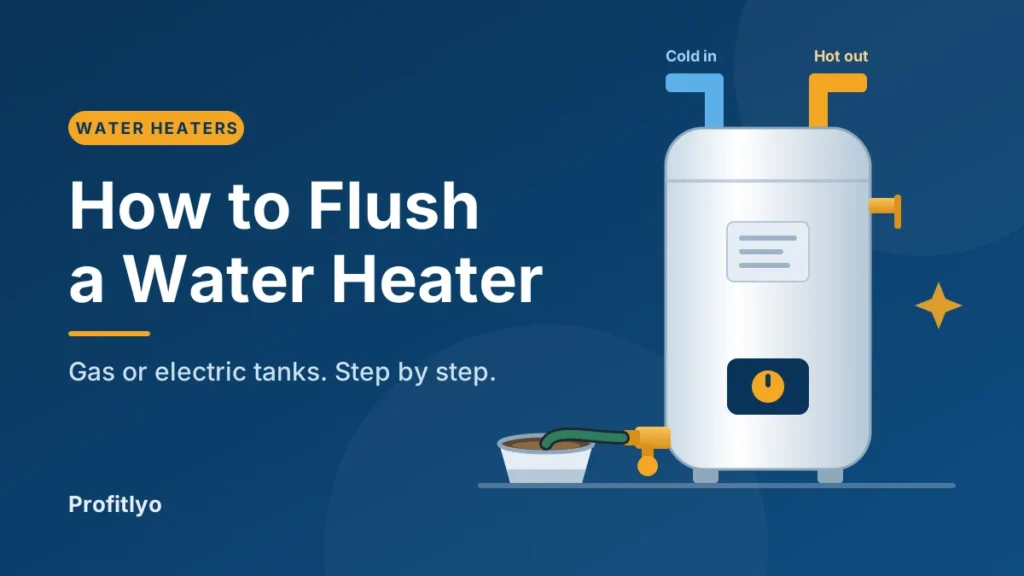
Your heater may be a tank model rather than a tankless one. In that case, my guide on how to flush a water heater shows the tank version.