Water softener maintenance is mostly simple: keep the salt tank at least half full, break up salt crusts, and clean the system once or twice a year.
Most of the work is DIY and takes minutes. The bigger jobs, like cleaning the brine tank, come around once every one to three years.
I’ll show you the full schedule, the exact cleaning steps, what it costs, and when to call a pro. This water softener system maintenance guide covers standard salt-based softeners.
Quick answer
- Water softener maintenance starts with the salt. Check it every 4 to 6 weeks and keep the tank at least half full, but not filled to the top.
- Use evaporated salt pellets. Skip table salt and rock salt.
- If the tank looks full but your water is hard, you probably have a salt bridge. Break it up with a broom handle.
- Add resin cleaner a few times a year, and more often if you have iron in your water.
- Clean the brine tank every 1 to 3 years, and move the bypass valve now and then so it doesn’t stiffen.
- Read your manual first. It overrides any general guide, including this one.
Does a water softener need maintenance?
Yes. A softener is a simple machine, but it isn’t a fit-and-forget one.
It swaps hardness minerals for sodium using a bed of resin beads. Salt recharges those beads, so the salt tank and the resin both need attention.
Skip water softener maintenance and the usual result is hard water again, with scale on fixtures and in your appliances.
That scale also builds up inside your water heater. If you have hard water, my guide on how to flush a water heater is worth a read too.
Google’s own summary of this topic says regular care can stretch a softener’s life to 15 to 20 years. That’s the upper end, so treat it as a goal, not a promise.
Water softener maintenance schedule
Here is the schedule I’d follow. It pulls together what EcoWater, Aquasana, Taskrabbit and several installers recommend.
- Every 4 to 6 weeks: check the salt level and look for a salt crust.
- Every few months: add resin cleaner, and move the bypass valve to bypass and back.
- Once a year: test your water hardness and check that the settings still match.
- Every 1 to 3 years: empty and clean the brine tank. Sources vary, from every year to every three years.
- When salt is mushy or bridged: clean it straight away. Don’t wait for the next scheduled job.
- Once a year (optional): book a technician to inspect valves and electronics.
Taskrabbit recommends a professional inspection once a year. That’s optional if you keep up with the basics.
Put the dates on your phone calendar. Water softener maintenance is easy to forget because the softener works quietly in the background.
How to check and add salt
This is the most common water softener maintenance job, and the one that matters most.
Lift the lid of the brine tank and look inside. You’ll see salt, and usually a few inches of water at the bottom.
- Check that the salt sits above the water line.
- If the salt is below half full, top it up.
- Pour the salt in slowly. Don’t fill all the way to the top.
- Poke the surface to make sure it’s loose, not a hard crust.
Why not fill it to the top? A very full tank makes salt bridges more likely.
Salt bags are heavy. Lift with your knees, or pour half a bag at a time.
Keep notes on how fast the salt drops. That tells you how often to refill.
Taskrabbit’s guide cites 40 to 80 pounds a month for a family of four. Use that only as a rough guide.
Which salt should you use?
Use evaporated salt pellets. The right salt makes water softener maintenance much easier.
EcoWater calls evaporated salt the best option, at 99.99% sodium chloride.
Rock salt is cheaper, but it carries more insoluble minerals. EcoWater says those can leave a muddy tank and reduce softening.
Don’t use table salt. Taskrabbit’s FAQ says to use salt labeled for water softeners.
Some brands sell salt with an iron-fighting additive. That’s useful if you have rust stains, but check that your softener supports it.
How to fix a salt bridge or salt mush
These two problems are behind a lot of “my softener stopped working” calls. They’re easy to miss, because the tank looks full.
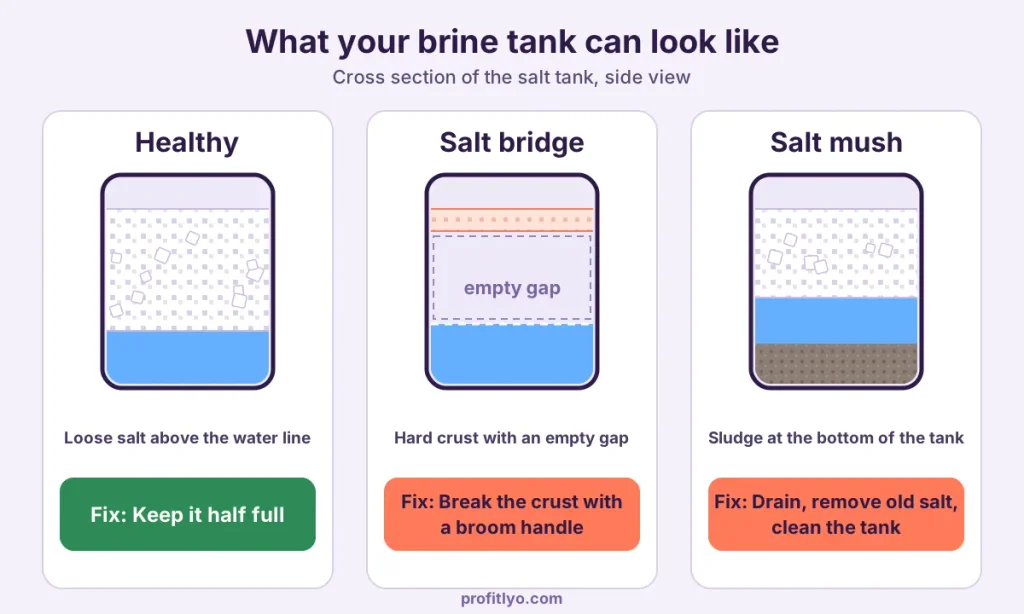
Salt bridge
A salt bridge is a hard crust that forms on top of the salt. Underneath, there’s an empty gap, so the water never touches the salt.
The sign is hard water even though the tank looks full. EcoWater lists humidity, temperature swings and the wrong salt as causes.
To fix it, push down on the salt with a broom handle. Break the crust and loosen what’s underneath.
Aquasana adds that a rubber mallet on the outside of the tank helps. A little warm water around the edges also works.
Salt mush
Salt mush is sludge at the bottom of the tank. Dissolved salt has recrystallized into a thick layer.
If the broom handle won’t break it up, you probably have mush. EcoWater says the only fix is to drain the tank, remove the old salt and refill with fresh salt.
That’s the point to clean the whole tank, which I cover below.
Water softener maintenance: cleaning the resin bed
Over time, iron, silt and other gunk coat the resin beads. The beads then soften less water.
The fix is a resin cleaner. EcoWater says to do it every few months, and Taskrabbit says monthly if your water has a lot of iron.
- Read the label on the cleaner and your softener manual.
- Measure out the dose the manufacturer recommends.
- Pour it into the brine well, the tube inside the salt tank.
- Start a manual regeneration.
Do it when salt is low, not right after a refill. That way you’re not wasting a full tank of salt.
One caution from InspectApedia: check with your softener’s maker before using an iron remover. Some products can harm the resin.
Make sure the cleaner is fully flushed out before you drink the water. Running a second regeneration is the usual way to do that.
How to clean a brine tank step by step
This is the biggest water softener maintenance job, and it takes about an hour. Most people do it every one to three years.
Clean it sooner if you find mush, a bad smell or lots of sludge.
- Put the softener on bypass and unplug it.
- Let the salt run low first if you can. It makes the tank much lighter.
- Scoop out the remaining salt and bail out the water.
- Scrub the inside with warm water, dish soap and a long-handled brush.
- Rinse well and tip out the dirty water.
- Optional: sanitize with 1/4 cup of bleach in about 2 gallons of water, per HomeServe. Leave it 15 minutes and scrub again.
- Rinse again until there’s no smell of bleach, then dry the tank.
- Add about 5 gallons of water and salt up to about halfway, as Aquasana suggests.
- Wait about 2 hours, plug the softener back in, take it off bypass and start a regeneration.
Never mix bleach with other cleaners. Rinse everything well, and follow your manual if it says not to use bleach.
Bypass valve and venturi valve
Two small parts get forgotten during water softener maintenance.
The bypass valve lets you shut the softener off from your plumbing. If it never moves, it can seize.
Move it to bypass and back every few months. Aquasana says at least once a month, so the exact timing varies. The goal is simply that it never stays still for years.
The venturi valve and injector pull brine into the resin tank. If they clog, the softener can’t draw salt water.
EcoWater says to clean the venturi twice a year. Some other sources say far less often. If your manual gives an interval, use that one.
How often should a water softener regenerate?
It depends on your water hardness, how much water you use and the size of your softener. There’s no single number.
Regeneration settings are part of water softener maintenance, so it helps to know how your model works.
Water Filter Guru says a full regeneration usually takes 2 to 3 hours. The stages are brine fill, backwash, brine draw, brine rinse and fast rinse.
Timed units run on a schedule, often 2 or 3 times a week at 3 a.m. Metered units regenerate based on how much water you’ve used.
Metered units waste less salt and water. If yours is a timed model, you can ask a technician whether a different setting suits your home.
Water softener maintenance for well water
Well water often carries more iron and sediment than city water. Both foul the resin faster.
That’s why water softener maintenance on a well works best on a tighter schedule.
Taskrabbit suggests cleaning the resin as often as monthly for iron-heavy water. HomeServe says twice a year for high iron.
LunsPro recommends a pre-filter for iron and sediment. A softener isn’t built to be an iron filter, so heavy iron needs its own treatment.
That pre-filter needs its own routine, and I explain how to look after a sediment pre-filter in a separate guide.
Heavy hard water is also tough on tankless heaters. I cover that in my guide to tankless water heater maintenance.
Signs your softener needs attention
Water softener maintenance isn’t only a calendar job. Your water tells you when something is wrong.
| What you notice | Likely cause | What to do |
|---|---|---|
| Hard water, but the tank looks full | Salt bridge | Break the crust with a broom handle |
| Crust won’t break, sludge at the bottom | Salt mush | Drain, remove old salt, clean the tank |
| Salt level hasn’t dropped in weeks | Bridge, or no regeneration | Check for a crust, then check power and settings |
| Hard water returns after fresh salt | Fouled resin or high iron | Use resin cleaner, test the water, then call a pro |
| Orange or brown stains | Iron in the water | Clean the resin more often, ask about an iron filter |
| Blank display or error code | Power or control problem | Check the outlet, read the manual, call a pro if it repeats |
A cheap hardness test strip tells you if the softener is really working. Test the water at a tap after the softener, once or twice a year.
How much does water softener maintenance cost?
DIY water softener maintenance is cheap. The regular costs are salt and resin cleaner.
Prices change by brand and store, so I’m not putting numbers on them for salt. Check the price per bag before you buy.
If you’re still deciding whether to buy a softener at all, my guide to the real cost of a water softener covers equipment, installation and 10 years of salt.
A professional repair costs more. HomeAdvisor lists an average of $559 for water softener repair, with a typical range of $162 to $985.
That’s repair, not routine upkeep, but it shows why catching problems early pays off. Plumber labor on that page averages $45 to $150 per hour.
EcoWater’s maintenance guide is also worth a look if you own one of their units.
Common water softener maintenance mistakes
- Using table salt or rock salt instead of evaporated pellets
- Filling the brine tank to the very top
- Never checking for salt bridges
- Mixing bleach with other cleaners
- Skipping the bypass valve for years
- Ignoring your manual
Water softener maintenance checklist
- Monthly or every 4 to 6 weeks: check salt, look for a crust
- Every few months: add resin cleaner, move the bypass valve
- Yearly: test hardness, check settings
- Every 1 to 3 years: clean the brine tank
- Always: read your manual, and write down the dates
Writing the dates down matters. Most people can’t remember when they last did it.
Frequently asked questions
Does a water softener need routine maintenance?
Yes. Routine water softener maintenance means checking the salt every 4 to 6 weeks, cleaning the resin a few times a year, and cleaning the brine tank every 1 to 3 years.
Can you service a water softener yourself?
Yes, most of it. Salt checks, bridge fixes, resin cleaner and tank cleaning are DIY jobs. Valve and electronic repairs are best left to a pro.
What is the average cost to service a water softener?
HomeAdvisor lists an average of $559 for repair, with a typical range of $162 to $985. Routine DIY upkeep costs only salt and resin cleaner.
Should a water softener be serviced?
An annual inspection is a good idea, according to Taskrabbit. It’s optional if you keep up with the basics yourself.
What is the average lifespan of a water softener?
Google’s summary says 15 to 20 years with regular care. Taskrabbit and LunsPro put resin beads at 10 to 15 years, so expect the resin to need replacing before the unit dies.
Can I flush the toilet when my water softener is regenerating?
Usually yes, but on a single-tank softener the water isn’t softened during regeneration. Water Filter Guru suggests scheduling it for a time like 3 a.m., and I’d keep laundry and long showers out of that window.
How long does water softener regeneration take?
Usually 2 to 3 hours in total, according to Water Filter Guru. Your manual will give the exact time for your model.
How do I know if my water softener is working?
Test the water with a hardness strip, and watch for spots on glass and a poor soap lather. If hard water comes back, check for a salt bridge first.
How often should I add salt?
Check every 4 to 6 weeks and top up when it’s below half full. How often that is depends on your hardness and household size.
Final thoughts
Check the salt, break the crusts, and clean the system on a schedule. That’s most of water softener maintenance.
Keep your manual handy, and test your water once in a while. Regular water softener maintenance saves you far more than it costs.
If your water turns hard even after cleaning, or you see error codes that keep coming back, call a professional.