Water filter maintenance comes down to one rule: change the cartridge on time and keep the housing clean.
Most home filters need attention every 3 to 12 months. The exact timing depends on the filter type and how dirty your water is.
In this guide I’ll show you the schedule for each type, how to change a whole house cartridge step by step, and what you can and can’t clean. This water filter maintenance guide covers whole house, under-sink, RO and UV systems.
Quick answer
- Water filter maintenance starts with the manual. The maker’s schedule beats any general guide, including this one.
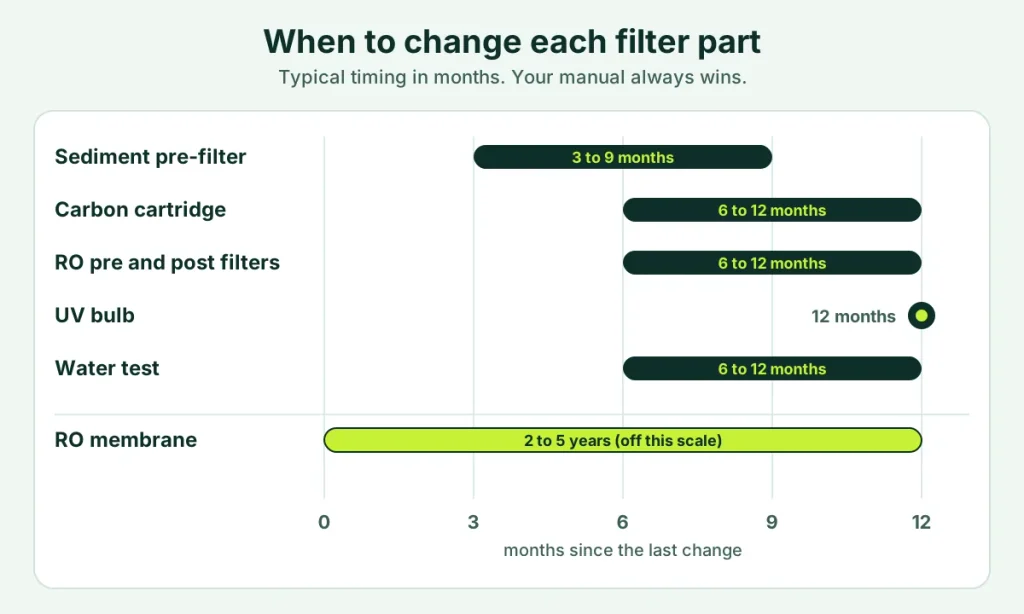
- Sediment pre-filters usually need changing every 3 to 9 months. Carbon cartridges usually last 6 to 12 months.
- RO pre and post filters need changing every 6 to 12 months. The RO membrane lasts about 2 to 5 years.
- A UV bulb is normally replaced once a year.
- Most cartridges should be replaced, not cleaned. Only filters sold as reusable can be washed.
- Low pressure, bad taste or visible gunk means the filter is due now, whatever the calendar says.
What water filter maintenance involves
A filter works by trapping things. Sediment, chlorine, lead and other particles stay in the cartridge instead of reaching your tap.
Over time the cartridge fills up. Water flows more slowly, and the filter stops catching as much.
The CDC says regular upkeep also keeps germs from growing inside the filter. So water filter maintenance is about safety, not only taste.
First, work out which system you have. The jobs are different for each one.
- Sediment filter: a pleated or spun cartridge that catches sand, dirt and rust.
- Carbon filter: a cartridge or media tank that reduces chlorine, taste and odor.
- Reverse osmosis (RO): an under-sink unit with several filters plus a membrane.
- UV system: a lamp that treats bacteria, with a glass sleeve around it.
A water softener is a different machine. It needs salt and resin care, which I cover in my guide to water softener maintenance.
Water filter maintenance schedule by system type
These are typical ranges. They come from installers and makers such as Pentair, and I’ve listed the spread where sources disagree.
| Part | Typical timing |
|---|---|
| Sediment pre-filter | Every 3 to 9 months |
| Carbon cartridge | Every 6 to 12 months |
| Large carbon or media tank | About every 5 years |
| RO pre and post filters | Every 6 to 12 months |
| RO membrane | Every 2 to 5 years |
| UV bulb | Every 12 months |
| Water test | Every 6 to 12 months |
Pentair puts a whole house sediment filter at 6 to 9 months and the media at roughly 5 years. Google’s summary says 3 to 6 months for sediment, which fits very dirty water.
Boshart suggests changing a whole house cartridge at least every six months to limit bacteria build-up. That’s a cautious rule, and a fair one if you’re unsure.
Pitcher and refrigerator filters follow their own packs. The EPA says to use the indicator light if there is one, or track the days or gallons yourself and set a reminder.
Whole house water filter maintenance: how to change the cartridge
This is the most common water filter maintenance job. It takes about 20 minutes once you’ve done it before.
The steps below follow Boshart’s guide. Check your own manual first, because housings differ.
You’ll need a filter wrench, a bucket, a clean cloth, and the right replacement cartridge. Keep a spare O-ring on hand too.
- Shut off the inlet and outlet valves on the filter to stop the water.
- Put the bucket under the housing.
- Turn the bowl counter-clockwise with the filter wrench and lower it away.
- Pull out the old cartridge and empty the water from the bowl.
- Take out the O-ring, wipe it clean and check it for cracks. Replace it if it’s damaged.
- Wash the bowl with a non-abrasive sponge, then rinse it and wipe the O-ring seat.
- Fit the new cartridge over the post in the bowl.
- Coat the O-ring with the lubricant your manual names and seat it evenly in its groove.
- Screw the bowl back on and tighten by hand only.
- Hold the red pressure relief button, if your filter has one, and open the inlet valve slowly until water comes out of the button.
- Open the outlet valve slowly, run the water for several minutes, then check every joint for leaks.
Don’t overtighten the bowl. Boshart warns against it, and a cracked bowl costs more than a new cartridge.
On lubricant, Boshart uses petroleum jelly. Google’s summary says food-grade silicone grease. Use whatever your manual specifies.
Boshart also sanitizes the bowl with about a tablespoon of bleach in a third of a bowl of water, then rinses. Only do that if your manual allows it.
The CDC says to wear gloves when you change a filter and wash your hands afterwards. It also says people with weakened immune systems should avoid changing filters themselves.
If you’re not comfortable with any of this, hire a plumber. That’s better than a leaking housing.
Can you clean a water filter instead of replacing it?
Usually no. Most cartridges are built to be replaced.
Tri County Water Conditioning says scrubbing a standard cartridge can push dirt deeper into the media and damage it. It also warns that tap water or vinegar soaks can add germs or break down the filter.
The exception is a filter made to be cleaned. Look for the word reusable and a cleaning method in the instructions.
ProOne gives a good example for its gravity ceramic filters. The ceramic is held under cool running water for about 2 minutes and scrubbed with the sponge supplied. Soap is not used, and water stays out of the filter stem.
ProOne also says its pleated pre-sediment filters can be rinsed out, and housings can be washed with soap and warm water.
That’s a brand-specific rule, so don’t copy it onto another filter. When in doubt, replace it.
One cleaning job is worth doing for any home. The EPA suggests removing the faucet aerator regularly and rinsing out trapped particles.
RO water filter maintenance
RO water filter maintenance has more parts, so it gets forgotten. An RO unit has pre-filters, a membrane, a post filter and a storage tank.
Google’s summary puts the pre and post filters at 6 to 12 months. The membrane is usually 2 to 3 years, and up to 5 in light use.
The storage tank and lines need sanitizing about once a year, according to the same summary. Use the method in your manual.
Water Unlimited, a Kinetico dealer, says its under-sink RO needs one sanitizing and cartridge change a year. That’s a handy anchor if you have no manual.
The best RO water filter maintenance habit is changing every filter in one visit. Put it in your calendar once a year.
UV light and well water systems
A UV lamp loses strength over time even if it still glows. Most are replaced every 12 months.
Wear gloves when you handle the glass sleeve. Water Unlimited warns that fingerprints can etch the quartz and reduce how well the light works.
Well water usually needs a tighter schedule. It tends to carry more sediment, so the pre-filter clogs faster.
If your well pump also loses its prime now and then, I explain priming a well pump in a separate guide.
If you have a softener as well, a clean pre-filter also protects it. I mention that pairing in my water softener maintenance guide, and the same pre-filter advice applies here.
Test a well supply every 6 to 12 months for hardness, bacteria and pH. The test tells you if your schedule is working.
Signs your filter needs changing now
Water filter maintenance isn’t only a calendar job. Your water gives you early warnings.
- Water pressure drops, or water flows slowly from the tap.
- Taste or smell changes, such as chlorine or a musty note.
- Gunk or particles show up in a glass of water.
- White scale builds up around faucet spouts, according to ProOne.
- An indicator light comes on, or you’ve passed the date in your log.
A plumbing company, A.J. LeBlanc Heating, adds a useful check. See whether the pressure drop is at one fixture or the whole house.
One fixture points to that tap’s aerator or valve. The whole house points to the filter.
Also, don’t trust taste alone. LeBlanc notes that water can taste fine while the filter has stopped doing its job.
Troubleshooting after a filter change
| What you notice | Likely cause | What to do |
|---|---|---|
| Housing leaks | O-ring pinched, dry or damaged | Shut off, remove the bowl, reseat or replace the O-ring |
| Spitting or hissing taps | Air in the line | Purge with the pressure relief button, then run taps |
| Pressure still low | Valve not fully open, or the wrong cartridge | Open both valves fully and check the model number |
| Cloudy water after the change | Trapped air or loose particles from a new cartridge | Run water for several minutes until it clears |
| Bowl won’t come off | Over-tightened last time | Use the correct filter wrench and keep pressure relieved |
If the filter still leaks or the pressure stays low, call a plumber. Don’t run the system without a filter as a long-term workaround.
How much does water filter maintenance cost?
Most of the cost of water filter maintenance is the cartridges. HomeAdvisor lists annual maintenance, including filter replacements and inspections, at $50 to $300 a year.
It also says most whole house filters last about 12 months. A plumber visit for the same job costs more, so DIY saves money here.
The same page puts a whole house system at about $2,273 to install on average, with a range of $1,129 to $3,540. That makes a $100 cartridge change look cheap by comparison.
HomeAdvisor says these figures were updated with automation, so treat them as a guide. Local prices vary.
Keep a simple water filter maintenance log
A log takes two minutes and saves guesswork. LeBlanc suggests recording a few basics for each filter.
- Model number and the correct replacement part.
- Installation date and the maker’s instructions.
- Service dates.
- Water test results, plus changes in pressure, taste or odor.
Put the next change date on your phone calendar. Add a note about which filter is for which tap.
Common water filter maintenance mistakes
- Running hot water through the filter. The EPA says never to do this. Filter first, then heat.
- Using the filter for showers and chores. The EPA warns that large volumes of water wear a point-of-use filter out faster.
- Using the wrong cartridge. The EPA says to use only the cartridge made for your filter.
- Cleaning a filter that isn’t reusable. It can damage the media.
- Overtightening the bowl. Hand tight is enough.
- Waiting for bad taste. By then the filter has been tired for a while.
The CDC adds one more point for whole-home filters. If your filter removes chlorine or other disinfectants, more germs can grow in your plumbing, so keep it maintained.
Water filter maintenance checklist
- Every month: look for leaks and check the pressure.
- Every 3 to 9 months: change the sediment filter.
- Every 6 to 12 months: change carbon and RO filters, and test your water.
- Every year: change the UV bulb, sanitize RO parts and clear the faucet aerator.
- Every 2 to 5 years: replace the RO membrane.
- Always: write down the date you changed each part.
Tankless heaters have their own inlet filter that needs cleaning. I cover it in my tankless water heater maintenance guide.
Water filter maintenance FAQs
How often should a water filter be serviced?
Check it monthly and replace parts on the maker’s schedule. For most homes that is every 3 to 12 months, plus an annual look at the whole system.
How often do you really need to replace a water filter?
Follow the date or gallon limit on the pack, or the indicator light. Replace it sooner if pressure drops or the taste changes.
How often should I change a whole house water filter?
For whole house water filter maintenance, most sediment cartridges are changed every 3 to 9 months. HomeAdvisor says most whole house filters last about 12 months.
How long can you leave water in a filter?
I can’t point to one official limit. If a filter has sat unused for a few days, run cold water through it for a minute or two before drinking.
After a long break, run it longer. If the water still smells off, change the cartridge.
Can water filters be cleaned and reused?
Only filters sold as reusable. Standard cartridges should be replaced, and cleaning them can damage the media.
Can bacteria grow in filtered water?
Yes, if a filter isn’t maintained. The CDC says upkeep keeps germs from growing in it.
The CDC also says a filter must have an absolute pore size of 0.3 micron or smaller, or use RO or similar methods, to remove bacteria. Check the label.
What’s the best way to clean a water filter?
Follow the cleaning method for your exact filter. For a reusable ceramic filter that usually means cool running water and a soft scrub, with no soap.
For a housing, soap and warm water is the usual rule. Rinse it well.
Does water filter maintenance void the warranty?
Changing cartridges as directed will not. Tri County says cleaning or altering a cartridge often does void coverage, so read the warranty first.
If my water tastes fine, is the filter still working?
Not always. Taste is not a reliable test, so go by the schedule and a water test.
Final thoughts
Good water filter maintenance is a few small jobs done on time. Write the dates down, buy the right cartridge, and replace instead of cleaning unless the filter is reusable.
If something looks wrong, shut off the water and call a plumber. A cheap fix now is better than water damage later.
Sources used: the CDC guide to home water filters, the EPA guide to maintaining a water filter and the HomeAdvisor water filtration cost guide.