Here is how to prime a well pump: turn off the power, fill the pump housing with clean water through the priming port, close it up and switch the power back on.
Most pumps that lose their prime can be fixed in about 15 to 30 minutes with a few gallons of water. This only applies to above-ground jet pumps, not submersible pumps.
In this guide I’ll show you how to prime a well pump step by step, what to do in special cases, and why a pump keeps losing its prime. I’ll also tell you when to stop and call a pro.
Quick answer
- Learning how to prime a well pump starts with safety. Switch off the pump’s breaker first.
- Open a faucet near the pressure tank so trapped air can escape.
- Remove the prime plug, then fill the housing slowly with clean water until it stays full.
- Reseal the plug, restore the power and let the pump run. It should build pressure within a few minutes.
- If it doesn’t, refill and try once more. Don’t let the pump run dry.
- A submersible pump can’t be primed by hand. If you have one, skip to the troubleshooting section.
Does your well pump need priming?
It depends on the type of pump. If you searched for how to prime a pump for well water, check your type first, because only some pumps need you to add water.
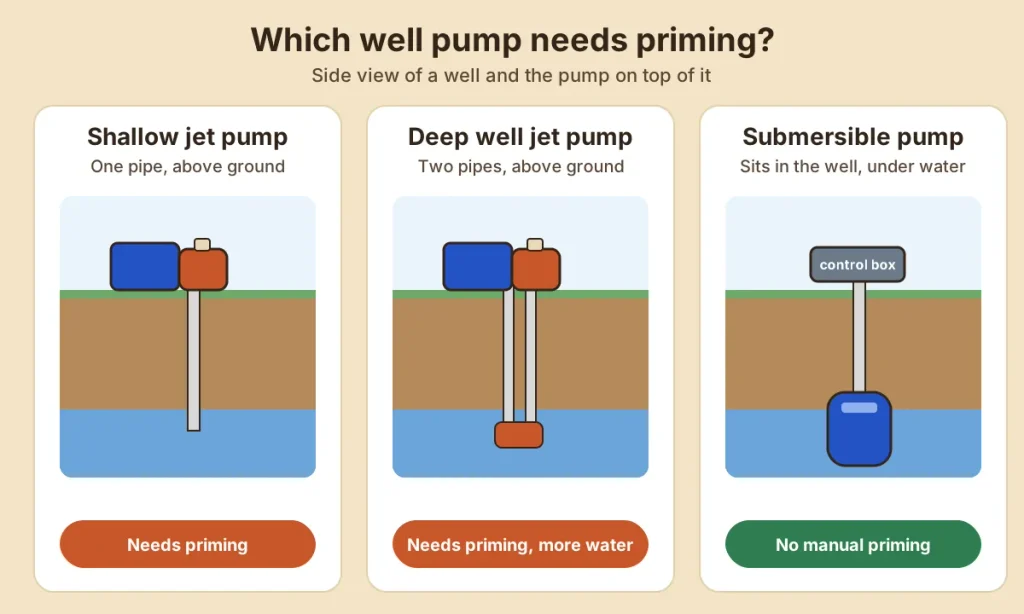
- Shallow well jet pump: sits above ground with one pipe going down the well. It needs priming.
- Deep well jet pump: also above ground, but with two pipes. It needs priming too, and usually more water.
- Submersible pump: sits down in the well, under the water. It doesn’t lose its prime, unless the water level drops below the pump.
InspectAPedia says a one-pipe jet pump suits wells no deeper than about 27 feet. NightOwl Monitoring puts it at about 25 feet.
An Alberta government fact sheet gives a limit of about 18 feet of total lift, which includes friction losses in the pipe. Treat all of these as rough guides, and check your own pump’s label.
Not sure which pump you have? If it’s a motor and a metal or plastic housing in the pump house, basement or garage, it’s probably a jet pump. If you only see a pipe going into the ground and a control box, it may be a submersible.
What you’ll need before you start
You don’t need much to learn how to prime a well pump. Gather the basics first so you don’t leave the pump half-open.
- A bucket, funnel or hose for clean water.
- 5 gallons of clean water. Sources say anywhere from 1 to 10 gallons, and long suction lines take more.
- A wrench or pliers that fit the prime plug.
- Teflon tape.
- A flashlight, rags and gloves.
Safety first
A well pump runs on electricity, and many run on 240 volts. Water and wiring don’t mix.
Whatever method you use for how to prime a well pump, switch off the breaker first.
- Switch off the breaker. Don’t rely on the pressure switch alone.
- Keep your hands dry and stay away from any damaged wiring.
- Use clean water. Dirty water can end up in your plumbing.
- Loosen the plug carefully. John’s Well Drilling warns that the area can still hold some pressure.
- Don’t run the pump dry. More on that below.
If the pump house is flooded, or you see damaged wiring, don’t go in. Call an electrician or well contractor.
How to prime a well pump, step by step
This is how to prime a well pump of the above-ground shallow well jet type. Your manual always overrides this guide.
- Turn off the power to the pump at the breaker.
- Open a faucet close to the pressure tank. This lets trapped air out of the system.
- Find the prime plug or cap on top of the pump housing. Remove it with a wrench or pliers.
- Pour clean water into the port slowly. Stop when the housing is full and the water stays at the top.
- Wait a minute for air bubbles to rise, then top it off again.
- Wrap the plug threads with fresh Teflon tape and screw the plug back in. Hand tight plus about a quarter turn is enough.
- Turn the breaker back on. The pump should start and begin building pressure.
- Watch the pressure gauge. If you get no pressure within 2 to 3 minutes, switch the power off and fill the housing again.
- When water flows steadily from the open faucet with no spitting, close the faucet.
That’s all there is to how to prime a well pump on a standard jet pump.
Google’s own summary says pressure should build in 1 to 5 minutes. NightOwl says a pump typically cuts off at about 50 to 60 PSI, though your switch setting may differ.
Don’t overtighten the plug. Haller Enterprises warns that it can crack plastic or strip the threads.
How to prime a well pump: signs it worked
Once you know how to prime a well pump, check that it worked. It’s easy to think the job is done when the motor starts.
- The pressure gauge climbs steadily and then the pump shuts off.
- Water from the open faucet runs smoothly, with no air bursts.
- The pump doesn’t turn on and off every few seconds.
- You can run an indoor tap for a few minutes and the flow stays steady.
If faucets still sputter, you may have trapped air or a leak in the suction line. Repeat the fill once more, then move on to troubleshooting.
How to prime a well pump in special cases
How to prime a well pump for the first time
A new pump has to be filled before it ever runs. Follow the same steps, and expect to use more water if the suction pipe is long.
Check every pipe fitting first. A small air leak on the suction side can stop a new pump from priming at all.
How to prime a well pump after a power outage
Water can drain back down the suction pipe if the foot valve is weak. Check the breaker first, then follow the normal steps.
If the outage came with flooding, don’t switch the power on yet. The CDC says a qualified electrician or pump contractor should check the wiring before power is restored.
How to prime a well pump that has been sitting
After months of sitting, the water in the housing may have evaporated or drained. Fill it as usual, and check hoses and fittings for cracks.
How to prime a well pump without a pressure tank
NightOwl says to leave a discharge open so air can escape while the pump primes. Don’t try this unless you know how your system is plumbed.
How to prime a well pump with a garden hose
A hose is fine for filling, but use a clean, drinking-water-safe hose. Disconnect it afterwards and never leave a hose connected to the pump.
For a deep well jet pump
A two-pipe system usually has more than one plug. Check your manual, and be ready for more water than a shallow pump takes.
With a submersible pump
There is nothing to prime. If you get no water, check the breaker, the control box, the pressure switch and the pressure tank. Then call a well contractor.
Signs your well pump has lost its prime
You’ll usually notice a few signs at once.
- No water at any tap, even though the pump runs.
- Faucets spit air before water comes out.
- The pump runs but the pressure gauge doesn’t climb.
- The motor sounds different, or runs hot to the touch.
InspectAPedia describes loss of prime as the motor running with no water in the pump chamber or well piping. That fits what most people see.
Sometimes the problem isn’t a lost prime. A dry well, a bad pressure switch or a leak between the well and the house can look the same.
Why your well pump keeps losing its prime
If you have to prime the pump again and again, priming isn’t the real fix. Knowing how to prime a well pump only treats the symptom, because something is letting the water or air in.
| Likely cause | What to check | Usual fix |
|---|---|---|
| Failing foot valve or check valve | Does the pump lose prime after sitting overnight? | Replace the valve |
| Air leak on the suction side | Fittings, unions and the plug seal | Retape or replace the fitting |
| Low water level in the well | Does it happen mainly in dry weather? | Call a well contractor |
| Damaged pump seal from dry running | Water weeping from the shaft area | Repair or replace the pump |
| Waterlogged pressure tank | Pump switching on and off rapidly | Check the tank’s air charge |
The foot valve sits at the bottom of the well pipe. A leaking one lets water drain back into the well, so the pump has to start from empty each time.
NightOwl puts a foot valve part at roughly $50 to $150. That excludes labor and pulling the pipe, so the full job costs more.
The Alberta fact sheet adds one more cause. Avoid high points in the suction line, because air can get trapped there and make priming difficult.
What happens if you don’t prime a well pump?
A jet pump isn’t built to run without water. Water cools it and lubricates the seal.
InspectAPedia says a pump may survive a minute or two dry, but half an hour with no water could burn out the motor or damage internal parts. NightOwl gives a tighter figure, with damage possible after 30 to 60 seconds.
The Alberta fact sheet is blunt. It says the pump should never run without the casing full of water.
So if you hear the pump running and no water comes, switch it off at once. Don’t wait to see if it fixes itself.
Well water, filters and your pump
Well water often carries sand and silt. The Alberta fact sheet notes that sand wears the impeller area and cuts the pump’s capacity and maximum pressure.
A sediment pre-filter helps protect the pump and everything after it. It needs changing on a schedule, and I cover how in my guide to how to look after a sediment pre-filter.
Many well homes also run a softener for hard water or iron. My water softener maintenance guide shows the well water tweaks that keep one working.
After a flood or any suspected contamination, don’t drink the water. The CDC says to use bottled water and talk to your local health department. It also says wells should be disinfected by a well or pump contractor.
When to call a pro
Even if you know how to prime a well pump, some jobs need a professional. I’d stop and call a well contractor or electrician if any of these apply.
- The pump still doesn’t build pressure after two careful prime attempts.
- You hear grinding, screeching or see smoke.
- The pump keeps losing its prime every few days.
- You have a submersible pump and no water.
- The pump house is flooded, or you see damaged wiring.
- You aren’t comfortable working near 240-volt power.
Mistakes to avoid
- Priming with the power on. It risks shock and damage.
- Using dirty water. It ends up in your plumbing.
- Not filling the housing completely. Air pockets stop the pump from drawing water.
- Overtightening the plug. You can crack the housing or strip the threads.
- Running the pump dry again and again. This is how seals get wrecked.
- Priming over and over without finding the leak. The pump will lose its prime again.
How to prime a well pump: quick checklist
- Before: breaker off, faucet open, water and tools ready.
- Fill: prime plug off, clean water in until it stays full.
- Seal: new Teflon tape, plug back on hand tight.
- Start: breaker on, watch the gauge for 2 to 3 minutes.
- Check: steady flow, no spitting, no rapid cycling.
- If it repeats: check the foot valve, the suction fittings and the water level.
How to prime a well pump: FAQs
How do you prime a well pump?
Turn off the power, open a nearby faucet, fill the pump housing with clean water through the prime plug, reseal it and switch the power back on.
How much water does it take to prime a well pump?
It depends on the pump and pipe length. Sources say anywhere from 1 to 10 gallons, so keep 5 gallons ready.
What happens if you don’t prime a well pump?
The pump runs dry and can overheat. It can damage the seal or burn out the motor, so switch it off if no water comes.
Can you prime a water pump while it’s running?
No. Turn the power off first, then fill the housing. Opening the plug on a live pump is unsafe.
How do you tell if a well pump has lost its prime?
The motor runs but no water comes out, or faucets spit air. The pressure gauge also won’t climb.
Will a well pump prime itself?
Some self-priming pumps can recover on their own. Many traditional jet pumps need to be primed by hand, especially after a long outage.
How do you get pressure back in a well pump?
Prime the pump first. If the pressure still won’t come back, check the pressure switch, the tank charge and the foot valve.
Do submersible pumps need priming?
No. They sit under the water, so there is nothing to prime. If you get no water, check the power, the controls and the water level.
Final thoughts
Knowing how to prime a well pump is a handy skill, and it only takes a few gallons and a few minutes. Switch the power off, fill it fully with clean water, seal it and restart.
If the pump loses its prime again and again, stop priming and find the cause. A failing foot valve or an air leak is the usual culprit.
Sources used: InspectAPedia’s guide to priming a well pump and the CDC guide to wells after an emergency.